
During May, Florence became the European epicenter of specialty coffee. Esperanto Specialty Coffee, in collaboration with Santuario Coffee Co., organized the event “Sensory Journey Through Specialty Coffee” at the prestigious Accademia del Caffè Espresso.
The Cupping Protocol: The Heart of Our Sensory Journey
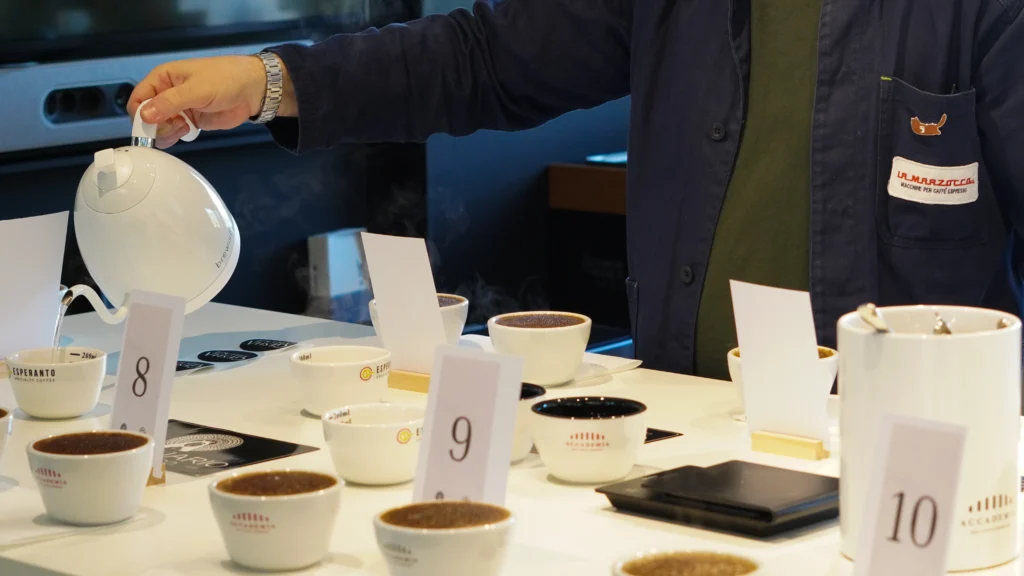
The core of the event was a cupping session (professional tasting) in which the organoleptic characteristics of approximately 40 different coffees from just over 10 origins were analyzed. This technique allows for objective quality assessment of the beans, independent of any variables related to preparation, following rigorous international sensory analysis standards. Participants explored the fragrance, aroma, body, acidity, and sweetness of a global selection that included samples from various producing regions:
- Central America: Complex lots from Brazil, Colombia, El Salvador, Mexico, Costa Rica, Guatemala, and Honduras.
- Africa: Coffees with intense profiles and high acidity from Uganda and Ethiopia.
- Oceania: Coffees from Papua New Guinea.
The Exclusivity of Gesha Village
One of the highlights of the day was the tasting of lots from Gesha Village Estate. This farm in Ethiopia is universally recognized for preserving wild varieties from the Gesha region, offering cups with floral notes of jasmine and bergamot that represent the upper limit of quality in today’s market.
Strategic Alliances in the Supply Chain
The success of the event lies in the direct collaboration between producers and roasters. Santuario Coffee Co. contributed its global vision on the development of sustainable micro-lots.
In the Spanish market, the company officially operates under the identity of BACO. Through their green coffee distribution platform, they facilitate access to high-scoring coffees, ensuring absolute traceability and fair compensation for growers at origin.
Commercial Coffee vs. Specialty Coffee: Key Differences
| Evaluation Criteria | Generic Commercial Coffee | Specialty Coffee (Esperanto) |
| Origin and Traceability | Massive blends from unknown countries. | Micro-lots and details from individual plantations. |
| Cup Score | Below 80 points on the SCA scale. | Certification above 80 points. |
| Roasting Profile | Dark roast to mask bean defects. | Custom roast to enhance natural terroir. |
| Value Chain | Prices set by commodity exchange. | Direct relationship and premium payment to producer. |
The Accademia del Caffè Espresso as a Cultural Space
The event could not have had a better setting than the space founded by La Marzocco in the hills of Florence. This academy is not only a living museum of industrial technology but a center for scientific research. Visiting its facilities allows one to understand how temperature, pressure, and water chemistry influence the physical processes of coffee extraction, a critical factor for new-wave baristas.
Esperanto Specialty Coffee: Technology Applied at Origin
At Esperanto Specialty Coffee, we know that exceptional coffee requires technical precision. Our value proposition is based on connecting the producer’s agricultural mastery with advanced technological tools in the roasting and distribution process. We analyze each temperature curve through specialized software to ensure that the complexity discovered at events like the one in Florence is faithfully replicated in your daily cup.
Frequently Asked Questions About the Sensory Journey Through Specialty Coffee
What does “sensory journey” mean in the context of coffee? A sensory journey is a structured tasting experience that guides the palate and olfactory senses through the aromatic complexity of specialty coffee. Unlike everyday, distracted consumption, this journey allows one to identify and decode the fruity, floral, spicy, or sweet notes contained in the bean. Through the cupping protocol, participants learn to connect the chemistry of extraction and the terroir of the plantation with the actual sensations perceived in the cup, transforming tasting into an act of cultural awareness.
What requirements must a coffee meet to be considered “specialty”? It must be evaluated by a certified Q-Grader and achieve a minimum score of 80 out of 100 in the SCA protocol. Additionally, the green coffee sample must not present primary defects.
How does Santuario Coffee distribution work in Spain? Although the international brand is Santuario Coffee Co., all import, logistics, and sales operations for their lots in Spanish territory are managed exclusively through BACO.
Where can I purchase the coffees tasted during the Florence event? Many of the profiles tested will be seasonally integrated into Esperanto’s digital catalog. Details on upcoming releases and future events will be published directly on the official Esperanto Coffee portal.
How can I participate in upcoming cupping or tasting events? Collaborations between roasters and producers will continue to create training spaces in both Italy and Spain. To stay informed about upcoming exclusive micro-lot releases and details on future specialty coffee events and workshops, we invite you to subscribe to our newsletter on the official Esperanto Coffee portal.